


Living with Trigeminal Neuralgia
Overview
Explore Our Cooking From The Heart Cookbook Series

Trigeminal neuralgia, also called tic douloureux, is nerve pain caused by dysfunction of the trigeminal nerve or it can even be caused by irritation or compression of the trigeminal nerve, that carries sensation from the face to the brain. It causes sudden, intense, electric-shock-like pain on one side of the face, which can be triggered by even light movements like chewing, talking, or smiling.
The condition is more common in women and adults over 50. Trigeminal neuralgia is a chronic condition and affects quality of life, but it isn’t life-threatening. Treatments, like medicine and surgery, can help manage your symptoms.
What is trigeminal neuralgia?
The term trigeminal refers to the trigeminal nerve which provides sensation to the face. Neuralgia is sharp, shock-like or burning pain that follows the path of a damaged or irritated nerve. In trigeminal neuralgia, the trigeminal nerve doesn’t function as it should, causing sudden, severe pain on one side of the face.
The trigeminal nerve
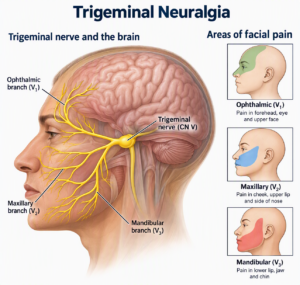
The nervous system is a network of nerves that carries messages between the body and the brain. The trigeminal nerve is a major nerve in the head with three branches, each responsible for sensation in a different part of the face.
The three branches are:
- Ophthalmic nerve – carries sensation from the eye, forehead and nose.
- Maxillary nerve – carries sensation from the upper teeth, gums, upper lip, cheek, lower eyelid and side of the nose.
- Mandibular nerve – carries sensation from the lower teeth, gums and lower lip.
Types of trigeminal neuralgia and its causes
There are three types of trigeminal neuralgia, each with its own underlying cause:
- Primary trigeminal neuralgia. This is when a vein or artery at the base of the brain presses on the trigeminal nerve. The pressure interferes with the nerve’s function causing pain. This is the most common type of trigeminal neuralgia.
- Secondary trigeminal neuralgia. This is caused by an underlying health condition or injury affecting the nerve, such as multiple sclerosis (MS), a surgical injury, a tumour pressing against the trigeminal nerve, facial trauma, or in some cases, stroke.
- Idiopathic trigeminal neuralgia. This is the least common type, and is diagnosed when no clear cause of the pain can be found.
Symptoms of trigeminal neuralgia
The main symptom of trigeminal neuralgia is sudden, severe facial pain in areas supplied by the trigeminal nerve. These are common pain patterns:
- Pain affects the cheek, jaw, teeth, gums or lips.
- It can stay in one area or spread across a wider part of the affected side.
- It may feel like shooting, stabbing or electric-shock sensations.
- Pain can be triggered by touching the face, chewing, speaking or brushing the teeth, or without warning.
- Less commonly, pain may affect the eye or forehead.
- Pain can last from a few seconds to several minutes.
- It can be accompanied by facial muscle spasms.
- Pain episodes can last for days, weeks, months or longer, sometimes followed by pain-free periods.
- Pain rarely occurs during sleep.
- Episodes may become more frequent and intense over time.
Triggers
Several triggers can set off the pain, including:
- Shaving
- Touching your face
- Eating
- Drinking
- Brushing your teeth
- Talking
- Applying makeup
- A light breeze blowing over your face
- Smiling
- Washing your face
Risk factors
Factors that increase the risk of trigeminal neuralgia include:
- Being female
- Being over 50
- Smoking
- High blood pressure
- Having multiple sclerosis
- Experiencing frequent migraines
- Having a family history of trigeminal neuralgia
What are the complications of trigeminal neuralgia?
Without effective management, trigeminal neuralgia can affect daily activities, emotional wellbeing and quality of life. People may experience:
- Anxiety, low mood or fear of another pain episode
- Social withdrawal and isolation
- Difficulty eating, drinking, speaking or working
- Medicine-related effects such as dizziness, tiredness or poor concentration
- Possible surgical complications, including pain, numbness, weakness, infection or hearing loss
- Impact on work performance and relationships
How is trigeminal neuralgia diagnosed?
Trigeminal neuralgia is usually diagnosed from your description of the pain, including the type of pain, the location (to help identify whether the trigeminal nerve is involved) and the triggers.
The following tests will also be used to confirm the diagnosis or identify the underlying cause:
- Neurological exam: Checks facial sensation and reflexes to locate the pain, identify the affected nerve branch and look for signs of nerve pressure or another condition.
- MRI (magnetic resonance imaging) scan: Looks for possible causes such as multiple sclerosis, a tumour or a blood vessel pressing on the nerve.
Because several conditions can cause facial pain, further tests may be needed to rule them out.
What are the treatments available for trigeminal neuralgia?
Treatment depends on the cause, your medical history, and the benefits, side effects and risks of each option. It may include medicines, surgery, radiation, injections or other procedures, as well as treatment for any underlying condition.
I. Medicine
These medications are used as the first line of treatment to lessen or block the pain signals:
- Antiseizure medication – carbamazepine, or oxcarbazepine
- Muscle relaxants – baclofen, used alone or in combination with carbamazepine.
- Pain relievers – lidocaine may be used on its own or with other medicines during severe episodes of pain.
II. Surgery
- Microvascular decompression (MVD): This procedure may be recommended when medicines do not relieve pain caused by a blood vessel pressing on the trigeminal nerve. Through a small opening behind the ear (through a hole in the skull), the surgeon moves or removes the vessel and may place a soft cushion between it and the nerve. MVD can provide long-term relief, although pain may return within three to five years in a small number of people.
- Neurectomy: If a vein is pressing on the trigeminal nerve, the surgeon may remove it. If no artery is compressing the nerve, part of the nerve may be cut.
III. Radiation
If MVD is not the right option for you, radiation treatment may help. Brain stereotactic radiosurgery, also known as Gamma Knife, is a non-invasive procedure that focuses radiation at the trigeminal nerve root to reduce pain.
IV. Other procedures
- Botox injections: Small studies suggest Botox may reduce pain when medicines are no longer effective.
- Glycerol injection: A needle is guided through the face to the trigeminal nerve, where glycerol is injected to damage pain-carrying fibres and block signals.
- Balloon compression: A balloon-tipped catheter is guided through the face and inflated against the trigeminal nerve to block pain signals.
- Radiofrequency thermal lesioning: While you are sedated, a needle is guided through the face to the trigeminal nerve, where heat is used to destroy selected pain-causing fibres.
All surgeries and procedures carry risks, so your healthcare provider will help determine the most suitable option for you, if needed.
Prevention
Trigeminal neuralgia can’t be prevented because it is often caused by factors such as pressure on the trigeminal nerve or underlying medical conditions. However, identifying and avoiding personal pain triggers may help reduce the frequency of painful episodes.
Living and managing

Because the trigeminal nerve is highly sensitive, these daily habits may help reduce irritation:
- Use a soft toothbrush and rinse with lukewarm rather than cold water.
- Wash your face gently using patting motions instead of rubbing the skin.
- Avoid chewy, hard or crunchy foods that may strain the jaw and nearby nerves.
- Choose softer options such as mashed potato, smoothies and tender meat.
- Avoid very hot or cold foods and drinks.
If stress causes you to clench your jaw or grind your teeth, try relaxation techniques such as deep breathing, meditation or gentle yoga to ease tension in the face and shoulders.
Support groups may provide emotional support, practical advice, and opportunities to connect with others facing similar challenges.
Some people report pain relief from complementary approaches such as acupuncture, aromatherapy, laser therapy, biofeedback or chiropractic treatment.
Sources
References
- American Association of Neurological Surgeons. (2024). Trigeminal Neuralgia. AANS (Accessed: 21 September 2026)
- Cleveland Clinic. (2024). Trigeminal Neuralgia Diagnosis and Treatment. Cleveland Clinic (Accessed: 21 September 2026)
- Durning, M.V. (2024). Trigeminal Neuralgia. Web MD (Accessed: 21 September 2026)
- Health Direct. Trigeminal neuralgia. Health Direct (Accessed: 15 October 2026)
- Mayo Clinic. Trigeminal Neuralgia Symptoms and Causes. Mayo Clinic (Accessed: 21 September 2026)
- Mayo Clinic. Trigeminal Neuralgia Diagnosis and Treatment. Mayo Clinic (Accessed: 21 September 2026)
- Rizor, R. F. (2026). Struggling With Trigeminal Neuralgia? 5 Ways to Manage the Pain. The Physicians (Accessed: 12 October 2026)
Popular articles


