


Perimenopause
- Overview
- What is perimenopause?
- When is perimenopause over?
- What are the symptoms of perimenopause?
- Causes
- Risk factors
- What are the complications of perimenopause?
- Can I get pregnant in perimenopause?
- How is perimenopause diagnosed?
- What are the treatments available for perimenopause?
- Prevention
- Living and managing
- When should I see a doctor?
Explore Our Cooking From The Heart Cookbook Series

Perimenopause is the natural transition that a woman’s body goes through before reaching menopause. During this time, women experience symptoms such as irregular periods, hot flushes, sleep problems and mood changes.
Although a woman’s fertility typically begins to decline around the age of 35, perimenopause usually starts in your 40s, though for some women it can begin earlier. Because it is a gradual change as your body produces less sex hormones, you could be in perimenopause for years.
Once you have had 12 consecutive months without a period, you are now officially in menopause. Most women reach menopause between the ages of 45 and 55.
Treatment is usually given when your symptoms are severe, or if there is abnormal bleeding.
What is perimenopause?
Perimenopause is the time period leading up to menopause when your hormone levels fluctuate. Estrogen and progesterone levels rise and fall unpredictably, and ovulation (release of an egg from the ovary) becomes irregular.
Because these hormone changes fluctuate, your symptoms can vary from month to month. Symptoms will also vary from woman to woman. As long as you still get a period, you can still get pregnant.
Perimenopause can begin 8–10 years before menopause, with the average length about four years. Some women will only experience symptoms for a few months, and others will be in this phase for many years.
Perimenopause can be seen as having two stages: the early stage (when hormones fluctuate erratically) and the late stage (when your hormone levels drop consistently and your periods become less frequent).
When is perimenopause over?
You are in menopause when you have not had a period for 12 consecutive months. Your postmenopausal body will adapt to the new norm of having low hormones.
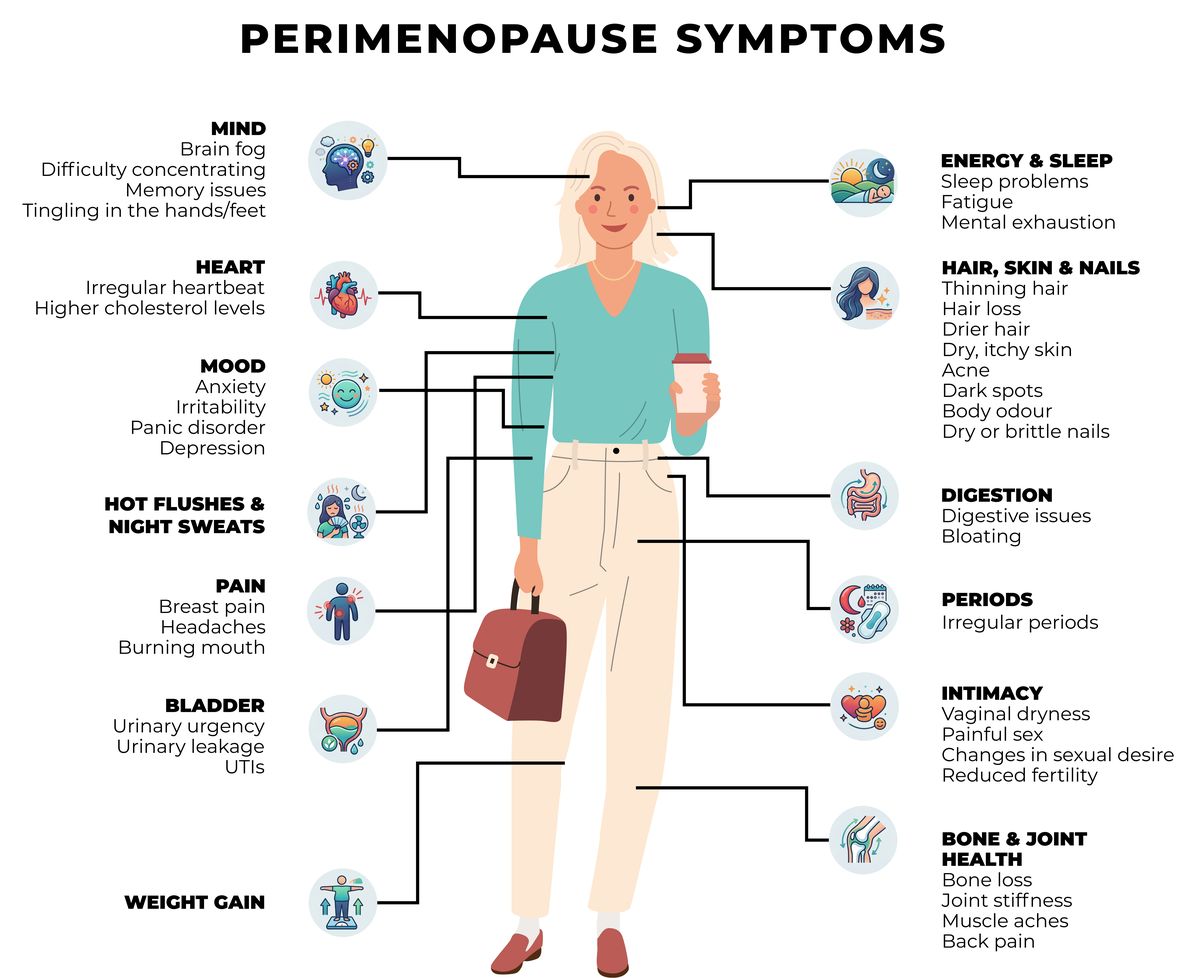
What are the symptoms of perimenopause?
Estrogen affects nearly every organ system of your body, therefore perimenopausal symptoms can be physical, emotional and cognitive. The most common symptoms are irregular periods, hot flushes and vaginal dryness.
Because the symptoms resemble symptoms of other conditions, speak to your healthcare provider about what you’re experiencing.
Causes
Perimenopause is a natural part of aging. As you approach your mid-40s, the ovaries produce less estrogen and progesterone. These hormonal fluctuations cause the physical and emotional symptoms of perimenopause.
Risk factors
Perimenopause is a natural life stage, but any damage to your ovaries can cause it to begin earlier:
- Smoking (linked to earlier menopause)
- If you got your period before age 11
- A family history of early menopause – you will most likely reach menopause around the same age as your mother
- HIV/Aids
- Infections like mumps
- Cancer treatment (chemotherapy or radiation)
- Hysterectomy (even if ovaries remain) or oophorectomy (removal of ovaries)
- Certain autoimmune diseases or thyroid conditions
- Chromosomal abnormalities, like Fragile X or Turner’s syndrome
What are the complications of perimenopause?
While perimenopause itself is not a disease, complications may arise due to lower estrogen levels:
- Osteoporosis (fragile bones)
- Increased cardiovascular risk
- Depression
- Abnormal uterine bleeding, which may signal other conditions
Can I get pregnant in perimenopause?
Even though your menstrual cycle may be irregular, because you’re still ovulating, you can still get pregnant during perimenopause.
How is perimenopause diagnosed?
Perimenopause is usually diagnosed based on:
- Age
- Menstrual history
- Reported symptoms
There is no single test that confirms perimenopause. Hormone levels fluctuate daily, so blood tests are not reliable for diagnosis. Thyroid testing may be done to rule out other causes of symptoms.
What are the treatments available for perimenopause?
Treatment depends on how severe your symptoms are and how they affect your quality of life. Your treatment will be personalised according to your medical history.
1. Hormone therapy (HT)
Hormone Therapy (HT) is the most effective treatment for dealing with symptoms such as hot flushes.
- Estrogen in the form of a patch, pill, gel or spray is the most effective treatment for hot flushes and night sweats. Local (vaginal) estrogen can also help with dryness and bladder symptoms. If you’ve had a hysterectomy, you will usually go on estrogen-only therapy. Doctors will recommend the smallest, effective amount of HT for the shortest time possible.
- Combination therapy (estrogen progesterone therapy or EPT) combines doses of estrogen and progesterone (also called progestin, a synthetic progesterone). Women who still have a womb need progesterone to help reduce the risk of uterine cancer, which increases when you only take estrogen. Combination therapy comes in the form of pills or skin patches.
- Progesterone is often taken in pill form, either with estrogen or on its own. When taken on its own, it is usually a type called micronised or “bioidentical” progesterone, which your body can absorb easily.
Before prescribing HT, some doctors may request a medical examination, an annual gynaecological examination and a mammogram.
2. Non-hormonal medicines
- Certain antidepressants (SSRIs): to help with mood disorders or hot flushes
- Gabapentin: seizure medication for hot flushes
- Oxybutynin: for overactive bladder and bladder leakage
- Vaginal creams and lubricants: for vaginal dryness
Prevention
Perimenopause cannot be prevented, but healthy lifestyle choices can reduce complications:
- Stop smoking.
- Maintain a healthy weight.
- Eat a balanced diet rich in fibre, calcium and vitamin D.
- Exercise regularly.
- Limit alcohol.
- Attend routine health screenings.

Living and managing
Perimenopause is a natural phase of life, and you can manage symptoms successfully. Here are some easy, practical ways to manage symptoms:
- For hot flushes, wear loose, comfortable clothing with cotton fabric and layered clothing.
- For night sweats and hot flushes, carry a small spray bottle of water and spray it on the back of your neck, wrists and knees when you feel a hot flush coming on.
- Do weight-bearing exercises, like hiking or strength training.
- Get into a consistent sleep routine.
- Use lubricants for vaginal dryness. Don’t use Vaseline (which can cause infection and damage condoms) and avoid products with glycerin, parabens or perfume.
- Actively manage your stress.
- Get regular check-ups with a healthcare provider or your doctor.
- Keep a symptom diary to help track your symptoms.
- Speak to friends and family about what you’re experiencing, or join a support group, even if it’s online.
- Try vitamins and supplements for added support; while not as effective as hormone therapy, the following are well-known vitamins and supplements for perimenopause: creatine, protein, vitamin D, calcium, Omega-3s (fish oil), zinc and magnesium.
When should I see a doctor?
Speak to your doctor when:
- You’re having very heavy or very long periods
- Your symptoms are impacting your quality of life
- You want advice on HRT (hormone replacement therapy) or symptom management
- You have bleeding after menopause
References
- Brighten, J. (2025). When to take progesterone for perimenopause. Dr Jolene Brighten. Available from https://drbrighten.com/progesterone-for-perimenopause (Accessed: 11 June 2026)
- Cleveland Clinic. (2025). 29 Perimenopause Symptoms You May Not Know About. Cleveland Clinic. Available from https://health.clevelandclinic.org/weird-symptoms-of-low-estrogen (Accessed: 19 February 2026)
- Cleveland Clinic. (2024). Perimenopause. Cleveland Clinic. Available from https://my.clevelandclinic.org/health/diseases/21608-perimenopause (Accessed: 19 February 2026)
- Cleveland Clinic. (2026). Premature and Early Menopause. Cleveland Clinic. Available from https://my.clevelandclinic.org/health/diseases/21138-premature-and-early-menopause (Accessed: 12 June 2026)
- Cherney, K. (2025). Premenopause, Perimenopause, and Menopause. Healthline. Available from https://www.healthline.com/health/menopause/difference-perimenopause (Accessed: 20 February 2026)
- Malcolm, K. (2026). 7 Essential Supplements to Ease the Perimenopausal Transition. The Nutrition Institute. Available from https://www.thenutritioninstitute.com/za/en/blog-perimenopause-supplements-for-hormone-balance (Accessed: 19 February 2026)
- Mayo Clinic. (2025a). Perimenopause Symptoms & Causes. Mayo Clinic. Available from https://www.mayoclinic.org/diseases-conditions/perimenopause/symptoms-causes/syc-20354666 (Accessed: 19 February 2026)
- Mayo Clinic. (2025b). Perimenopause Diagnosis and treatment. Mayo Clinic. Available from https://www.mayoclinic.org/diseases-conditions/perimenopause/diagnosis-treatment/drc-20354671 (Accessed: 19 February 2026)
- My Menopause Center. (n.d.). Signs Perimenopause Is Ending: What to Expect in the Final Stages. My Menopause CenterAvailable from https://www.mymenopausecentre.com/menopause-stages/perimenopause-to-menopause/signs-perimenopause-is-ending/ (Accessed: 20 February 2026)
- Rotter, J. (2026). Menopause: 11 Things You Should Know. Healthline. Available from https://www.healthline.com/health/menopause/menopausefacts (Accessed: 20 February 2026)
- Shetty, M. & Song, F. Top 6 Supplements for Women 40+. Stanford Lifestyle Medicine. Available from https://lifestylemedicine.stanford.edu/supplements-for-women-40/ (Accessed: 12 June 2026)
- Stanborough, R.J. (2024). What to Know About Progesterone Therapy for Menopause. Healthline. Available from https://www.healthline.com/health/progesterone-for-menopause (Accessed: 8 June 2026)
- South African Menopause Society. (2021). Menopause: A guide to understanding the menopause. South African Menopause Society. Available from https://www.menopause.co.za/wp-content/uploads/2021/10/A-guide-to-understanding-the-menopause-English-WEB-1.pdf (Accessed: 11 June 2026)
References
- Brighten, J. (2025). When to take progesterone for perimenopause. Dr Jolene Brighten. Available from https://drbrighten.com/progesterone-for-perimenopause (Accessed: 11 June 2026)
- Cleveland Clinic. (2025). 29 Perimenopause Symptoms You May Not Know About. Cleveland Clinic. Available from https://health.clevelandclinic.org/weird-symptoms-of-low-estrogen (Accessed: 19 February 2026)
- Cleveland Clinic. (2024). Perimenopause. Cleveland Clinic. Available from https://my.clevelandclinic.org/health/diseases/21608-perimenopause (Accessed: 19 February 2026)
- Cleveland Clinic. (2026). Premature and Early Menopause. Cleveland Clinic. Available from https://my.clevelandclinic.org/health/diseases/21138-premature-and-early-menopause (Accessed: 12 June 2026)
- Cherney, K. (2025). Premenopause, Perimenopause, and Menopause. Healthline. Available from https://www.healthline.com/health/menopause/difference-perimenopause (Accessed: 20 February 2026)
- Malcolm, K. (2026). 7 Essential Supplements to Ease the Perimenopausal Transition. The Nutrition Institute. Available from https://www.thenutritioninstitute.com/za/en/blog-perimenopause-supplements-for-hormone-balance (Accessed: 19 February 2026)
- Mayo Clinic. (2025a). Perimenopause Symptoms & Causes. Mayo Clinic. Available from https://www.mayoclinic.org/diseases-conditions/perimenopause/symptoms-causes/syc-20354666 (Accessed: 19 February 2026)
- Mayo Clinic. (2025b). Perimenopause Diagnosis and treatment. Mayo Clinic. Available from https://www.mayoclinic.org/diseases-conditions/perimenopause/diagnosis-treatment/drc-20354671 (Accessed: 19 February 2026)
- My Menopause Center. (n.d.). Signs Perimenopause Is Ending: What to Expect in the Final Stages. My Menopause CenterAvailable from https://www.mymenopausecentre.com/menopause-stages/perimenopause-to-menopause/signs-perimenopause-is-ending/ (Accessed: 20 February 2026)
- Rotter, J. (2026). Menopause: 11 Things You Should Know. Healthline. Available from https://www.healthline.com/health/menopause/menopausefacts (Accessed: 20 February 2026)
- Shetty, M. & Song, F. Top 6 Supplements for Women 40+. Stanford Lifestyle Medicine. Available from https://lifestylemedicine.stanford.edu/supplements-for-women-40/ (Accessed: 12 June 2026)
- Stanborough, R.J. (2024). What to Know About Progesterone Therapy for Menopause. Healthline. Available from https://www.healthline.com/health/progesterone-for-menopause (Accessed: 8 June 2026)
- South African Menopause Society. (2021). Menopause: A guide to understanding the menopause. South African Menopause Society. Available from https://www.menopause.co.za/wp-content/uploads/2021/10/A-guide-to-understanding-the-menopause-English-WEB-1.pdf (Accessed: 11 June 2026)


